Finding the Lessons

I try to post well in advance of the upcoming Sunday.

You will want to scroll down to find the bible study for the lessons closest to the upcoming Sunday.

The blog will be labeled with proper, liturgical date, and calendar date.

You can open the monthly calendar to the left and find the readings in order.

You can also search below by entering the liturgical date, scripture, or proper. This will pull up all previous posts.

Enjoy.

Search This Blog by Proper and Year (ie: Proper 8B or Christmas C or Advent 1A)

Showing posts with label Beatitudes. Show all posts

Friday, October 3, 2025

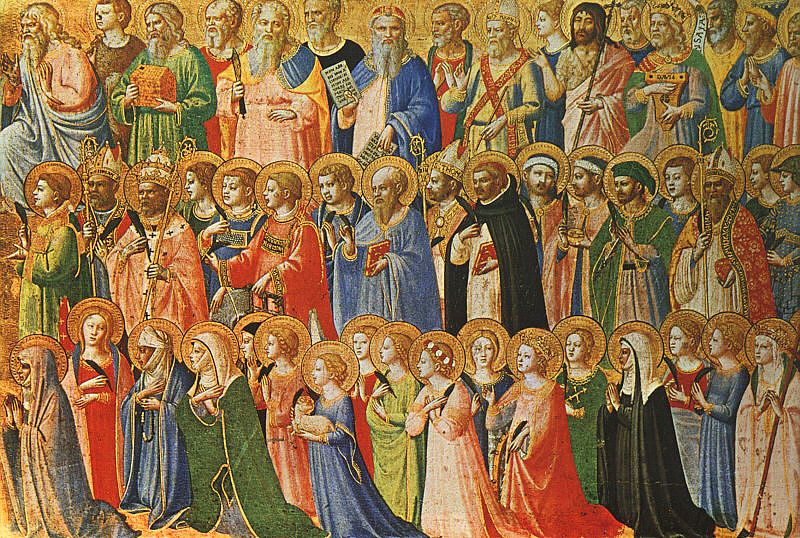
All Saints C - November 1, Sunday November 2, 2025

Many Congregations Will Transfer All Saints to Sunday this 
Week; So here is your bonus Hitchhiking for All Saints

A Good Passage to Begin With:
Ecclesiasticus 44:1-10,13-14

44Let us now sing the praises of famous men,
our ancestors in their generations.
2 The Lord apportioned to them* great glory,
his majesty from the beginning.
3 There were those who ruled in their kingdoms,
and made a name for themselves by their valor;
those who gave counsel because they were intelligent;
those who spoke in prophetic oracles;
4 those who led the people by their counsels
and by their knowledge of the people’s lore;
they were wise in their words of instruction;
5 those who composed musical tunes,
or put verses in writing;
6 rich men endowed with resources,
living peacefully in their homes—
7 all these were honoured in their generations,
and were the pride of their times.
8 Some of them have left behind a name,
so that others declare their praise.
9 But of others there is no memory;
they have perished as though they had never existed;
they have become as though they had never been born,
they and their children after them.
10 But these also were godly men,
whose righteous deeds have not been forgotten;
13 Their offspring will continue for ever,
and their glory will never be blotted out.
14 Their bodies are buried in peace,
but their name lives on generation after generation.

Quotes That Make Me Think

"Saints are "holy ones" (Greek: hagioi), the 'blessed of God' (Greek:makarioi: Luke 6:20-22). But who are they really?"

Commentary, Luke 6:20-31, David Tiede, Preaching This Week,WorkingPreacher.org, 2010.

"This is a great text to preach as a high calling to the character of Christian community. Preaching it as pre-conditions for being resurrected - that would be a mistake. Preaching it as a calling to live as those who have been raised from the dead - that would be a blessing."

Holy Textures, Understanding the Bible in its own time and in ours, Luke 6:20-31, David Ewart, 2010.

General Resources for Sunday's Lessons from Textweek.com

Prayer
As one poor in spirit and gentle of heart, your Son, O God, came to live among us, that we might hear the charter of your kingdom and see those words made flesh in the mercy and peace with which he faced insult and persecution.  As we celebrate the witness of all the saints whose lives were shaped by the Beatitudes form us according to Christ's teaching and their example, that, having shared in the communion of the saints on earth, we might take our place among them in the joy of your kingdom. We ask this through our Lord Jesus Christ, your Son, who lives and reigns with you in the unity of the Holy Spirit, God forever and ever. Amen.

From Prayers for Sunday and Seasons, Year C, Peter J. Scagnelli, LTP, 1992.

Some Thoughts on Luke 6:20-31

Oremus Online NRSV Gospel Text

Resources for Sunday's Gospel

I don't normally do this, but this week I want to do a bit of comparison between the synoptic Beatitudes in Matthew and Luke. Let me begin with a bit about Matthew's version:

As we look at Jesus’ ministry, it is important to see that there is a framework at work in Matthew. One that is out of sync with our current reading cycle of Luke so is aware of shifting gears as you take on the All Saints' Day lessons. In these first chapters of the Gospel of Matthew we see that the individuals who come in contact with Jesus do not have to do anything, Jesus is not teaching about discipleship, he is not charging them to reform the religion of the time, and he is simply giving of himself. He is intentionally offering himself to those around him. The people in the first chapters of Matthew and in the Sermon on the Mount receive Jesus; this is the primary action taking place between those following and the Messiah himself.

Jesus is giving of himself to others.

The Sermon On the Mount begins in Chapter 4.25 and the introduction runs through 5.1. We are given the scenery, which is the mountain beyond the Jordan (previous verse). This continues to develop an Exodus typology which is the foundation of Matthew’s interpretive themes in these early chapters. It follows clearly when one thinks of the passages leading up to this moment: the flight from Egypt, baptism and now the Sermon on the Mount. In Matthew’s Gospel the first five chapters parallel the Exodus story. So, Jesus now arrives at the mountain where the law was given.

The structure of the following verses are beautiful and I offer them here so you can see how they play themselves out in a literary fashion (5.3-5.10).

5.3 Inclusive Voice: Theirs is the Kingdom of heaven.
5.10 Inclusive Voice: Theirs is the kingdom of heaven
5.4 Divine Passive Voice: They shall be comforted
5.9 Divine Passive Voice: They shall be called sons of God
5.5 Future Active Voice with Object: They shall inherit the earth
5.8 Future Middle Voice with Object: They shall see God
5.6 Divine Passive Voice: They shall be satisfied
5.7 Divine Passive Voice: They shall have mercy
Matthew uses these formulas and structures throughout the Gospel.

Scholars tell us that the classical Greek translation illustrates the pains that Matthew took as he rewrote Luke’s and Q’s Beatitudes to create the parallels we see. He also writes so carefully that when he is finished, there are exactly 36 words in each section of the Beatitudes (5.3-5.6 and 5.7-510). This combined with the parallels highlights the two sections that must have been meaningful to the church at Antioch (comprised of those who have fled persecution).

5.3ff describes the persecuted state of the followers of Jesus
5.7ff describes the ethical qualities of the followers of Jesus that will lead to persecution

The Beatitudes are blessings, not requirements. The teachings, therefore, are words of grace. In the initial teachings of Jesus’ ministry, healing comes before imperative statements, here Jesus preaches that grace comes before requirements and commandments. This is perennial Christian teaching: one must receive first before service.

The difficulties required of followers of Jesus presuppose God’s mercy and prior saving activity.

The Beatitudes are clear that the kingdom of God brings comfort, a permanent inheritance, true satisfaction and mercy, a vision of God and divine sonship. This may be Matthew’s most important foundation stone within the salvation story. We are given, through grace, our freedom to follow. We are like the Israelites and sons and daughters of Abraham, delivered so we may follow and work on behalf of God.

The Beatitudes also are prophetic as in the passage from Isaiah 61.1. Jesus is clearly the anointed one. Jesus is the fulfillment of the Old Testament prophecy from Isaiah, bringing Good News to those in need. Furthermore, the words of Jesus are the result of the prophecy and so they set him apart from all other teachers.

The beatitudes then are also words which not only promise Grace to the follower, they fulfill the prophetic words of the old message from Isaiah: Jesus was meek (11.29; 21.5), Jesus mourned (26.36-46), Jesus was righteous and fulfilled all righteousness (3.15; 27.4, 19), Jesus showed mercy (9.27; 15.22; 17.15; 20.30-1), Jesus was persecuted and reproached (26-7). The beatitudes are illustrated and brought to life in Jesus’ ministry, they are signs that he stands in a long line of prophets offering comfort to God’s people, and he is also clearly the suffering servant who epitomizes the beatitudes themselves. Origen wrote that Jesus is offering this grace he fulfills and embodies his own words and thereby becomes the model to be imitated.

The Beatitudes are words of proclamation. Are we in a place where we can articulate Jesus’ story and life as a fulfillment of God’s promises to his people?

The Beatitudes are words of mercy. Are we in a place where we can hear Jesus’ words for us? Have we allowed ourselves to be saved before we begin to work on Jesus’ behalf?

The Beatitudes are words of care for the poor. Are we in a place where we can hear Jesus’ special concern for those who are oppressed in the system of life? Are we ready to follow him into the world to deliver his people imitating the work of Moses and Jesus?

So let us turn to Luke now and see what the Gospel offers:  Luke’s version of the Beatitudes is quite different. While clearly laying out the boundaries of those who belong within the reign of God Jesus then turns to charge those who follow in the working of God’s will in their lives and in their discipleship.
Love your enemies
Do good to those who hate you
Bless those who curse you
Pray for those who abuse you
If anyone strikes you on the cheek, offer the other also from anyone who takes away your coat do not withhold even your shirt

Give to everyone who begs from you if anyone takes away your goods, do not ask for them again

Do to others as you would have them do to you.

These are the standards of our lives in Jesus Christ. Many of us pray for God’s will in our lives, here it is.

Luke Timothy Johnson says, “Ultimately, of course, Luke grounds this morality in the covenantal attitudes and actions of God. As God is kind toward all creatures, even those who are not themselves kind, even wicked, so are these disciples to be. The reward is itself the reality of being of God toward the world.” (LTJ, Luke, 112)

We blessed in so many ways. One of those ways is the unequivocal invitation to be members of God’s creation and inheritors of his reign. This is our baptismal promise. We cannot read this without Matthew’s own story of it residing deep within the ancient history of the Israelites planted firmly within our current mission context. We are also blessed because God does not simply invite us but beckons us to join him in the garden as partners in the stewardship of his reign. You and I receive the blessing of God for the purpose of blessing the world through our mission and ministry.

Some Thoughts on Ephesians 1:11-23


Resources for Sunday's Epistle

Our passage is a kind of blessing or beginning for the whole text; within it is a brief summary of Ephesians.  Many scholarly articles and texts spend a great deal of time using this blessing section as a tool for touching on the themes of the letter.  Our context though is in the midst of the celebration of All Saints and it is to that particular message that I think we should try and listen as we prepare for preaching.

The first piece of the passage is not news to those who read a great deal of Paul.  Paul is clear our inheritance (Jew or Greek) is always obtained by and through the work of God.  Moreover, the purpose of our receiving such an inheritance is the praise and glory of God.
20God put this power to work in Christ when he raised him from the dead and seated him at his right hand in the heavenly places, 21far above all rule and authority and power and dominion, and above every name that is named, not only in this age but also in the age to come. 22And he has put all things under his feet and has made him the head over all things
God's grace is abundant and always comes first and it is our response then that marks us outwardly as Christ's own, even though that claim is assured only by the work of Jesus and the Holy Spirit.  We were "marked" and "sealed"; words that echo even today in our baptismal liturgies.

Even now, Paul reminds us, we are being redeemed.  Such a faith is what Paul speaks to in verse 15:  "I have heard of your faith in the Lord Jesus and your love toward all the saints..."  - the mark of the outward claim God has on our hearts.  Love for others is key to our ministry and our mission; it is the mark by which we are known as Christ's own forever.

Paul then urges that the church in Ephesus is filled with this Holy Spirit and that the "eyes of your heart" be enlightened so that they may see clearly what is God's hope.  This hope is nothing less than a) that all creation praises God; b) that all people are drawn to God for this purpose.  This is the richness of the witness born by the saints who believe and have lived and are living accordingly.

Paul believed that a Christian, a follower of Jesus, would live such a life that others in witnessing the living out of faith would then turn to God and receive salvation.  He is very clear that people don't save other people, nor do they save themselves.  This is once and always God's work.  Nevertheless, the Christian who lives out the saintly life is one who lives life for God's glory so that they might join the rag tag group and be saved by God themselves. (I Cor 7.16; I Cor 10:31-33)

God is even now saving us.  Paul's invitation is to live a saintly life by acting as a people who are saved and that such action is marked by a love of neighbor just as the love of God is the saving power.


Monday, February 10, 2025

Seventh Sunday after Epiphany - February 23, 2025


Prayer


Lord, help me not to be too quick to assume my enemy is a savage just because he is my enemy. Perhaps he is your enemy because he thinks I am a savage. Or perhaps he is afraid of me because he feels that I are afraid of him. And perhaps if he believed I were capable of loving him he would no longer be my enemy. Lord, help me not to be too quick to assume my enemy is a savage just because he is my enemy.

Lord, help me not to be too quick to assume that my enemy is an enemy of God just because he is my enemy. Perhaps he is my enemy precisely because he can find nothing in me that gives glory to God. Perhaps he fears me because he can find nothing in me of God's love and God's kindness and God's patience and mercy and understanding of the weaknesses of men. Lord, help me not to be too quick to assume that my enemy is an enemy of God just because he is my enemy.

Lord, help me not to be too quick to condemn the man who no longer believes in God, for it is perhaps my own coldness and avarice, my mediocrity and materialism, my sensuality and selfishness that have killed his faith. Lord, help me not to be too quick to condemn the man who no longer believes in God. Amen

Prayer adapted from Thomas Merton, from  New Seeds of Contemplation (New York: New Directions Publishing Corporation, 1961).


Luke 6:27-38

"Jesus? life is the best exposition of his teaching: self giving love even in utmost adversity generates life for oneself and for others. It is participation in God?s life."
"First Thoughts on Year C Gospel Passages in the Lectionary: Epiphany 7,"William Loader, Murdoch University, Uniting Church in Australia, 2001.


"The word used here for love, agape in Greek, does NOT mean romantic love, liking, or even friendship. What it does mean is whole-hearted, unreserved, unconditional desire for the well-being of the other. Expecting nothing in return."
Holy Textures, Understanding the Bible in its own time and in ours, Luke 6:27-38, David Ewart, 2013.


"Jensen (Preaching Luke's Gospel) offers this possible conclusion to a sermon on this text: Jesus' word for us today is: "I call you to live your lives out of an alternative vision of reality. I call you to live your lives as lives that reverse the values of this culture. I call you to love your enemy; turn the other cheek; give your possessions to those in need and judge not the lives of others. Be merciful even as I am merciful. I have come to nourish your entire life with my mercy. I have come to empower you with mercy in order that you may, indeed, live a new kind of life in this world." [p. 82]"
Exegetical Notes by Brian Stoffregen at CrossMarks Christian Resources.


Do not think that you can show your love for Christ by hating those who seem to be his enemies on earth... Suppose they really do hate him: nevertheless he loves them, and you cannot be united with him unless you love them too.

If you hate the enemies of the Church instead of loving them, you too will run the risk of becoming an enemy of the Church, and of Christ; for he said: Love your enemies, and he also said: He that is not with me is against me. Therefore if you do not side with Christ by loving those that he loves, you are against him.

But Christ loves all people. Christ died for all people. And Christ said there was no greater love than that a man should lay down his life for his friend.

Thomas Merton, from  New Seeds of Contemplation (New York: New Directions Publishing Corporation, 1961).


Oremus Online NRSV Text

We have just read the sermon on the mount, the admonitions that followed, the calling of the disciples to be about the work of bringing justice to the world by serving the poor, hungry, sorrow filled, and those who are hated.

It is as if he turns to the crowd now, and makes a larger pronouncement. He suggests that justice will not be brought about in the world's terms. In other words, justice will not be brought by a revolution of the poor who violently overthrow those in authority and in power. This is not a worldly tale of a new kingdom stomping out a worldly one and then taking its place in the seats of power. (The disciples will talk about this often.) No. This is a wholly other kind of revolution.

It is one where violence is met by peace. He calls people to bless and pray for those who hate, despise, or persecute. He invites people to give their shirt and their coat to those who ask or take from them.

He reminds them that even the sinners are merciful to those whom they like. So, the Gospel is going to be different. It is about loving those who are enemies, forgiving those who persecute us and cause us harm, and caring for those who do us evil.

This is not a "doing good" or "being good" word from Jesus as an economic exchange. It is not about being nice so others will in turn be nice to you.

Walter Wink in his book Engaging the Powers does an excellent job of pulling apart the social context of this passage. He explains that turning the other cheek requires a second blow with a soiled hand. There is a particular shame code at work here and by so doing the person who strikes the second blow is revealed as having defiled the other. Likewise, to give away all your clothing is to be naked. It was forbidden to do this and Jesus is revealing that it is an unjust demand that bring's shame upon the person who takes your clothing. Wink and others talk a bit more about Matthew's version as Jesus is specific about the cheek and adds an invitation to walk an extra mile. This by the way requires just payment for inscription and puts the soldier who requires it in the debtor's seat. Much is written about these non violent invitations to resist. Furthermore, there is a good bit of debate as to Jesus' intended audience and outcome. Is this about communal/village life? Or, is this revolutionary engagement with the powers and authorities. It may indeed be both.

We need though to remember. This is not a bold new code being ascribed by Jesus to those who follow God or who follow him. No, in fact he is inviting the people to remember the conditions prescribed in Leviticus and Deuteronomy. (See Leviticus 18-20) These are attitudes and requirements of love and mercy and forgiveness that reveal God's Holy people to be God's people. This is part of what differentiates them from others they will come to meet in the promised land. In fact the call to care for a stranger or sojourner in their land is an opportunity to reveal how different God's people are. See Leviticus 19 or Proverbs 25:21-22 to understand that God's people are a particular kind of people who are known for their hospitality, their kindness, and care - even to their enemies. What Jesus does is to continue God's teachings and to call people back into covenant with God.

Moreover, Jesus expands this beyond the communal life of first century religious life. Here is where I think it gets interesting. Jesus not only calls the religious to follow these prescriptions but to do so with those who are different, who do not believe, who have many gods, who are unclean, and who are outside of the religious theological sphere that breathes a rarified air of insulation. Jesus is inviting the whole of the world to be reshaped by this invitation. God's people, in Jesus' imagination, are all of the people...not just the faithful religious who can trace their ancestry back.

Furthermore, this is a key Gospel paradox and no mere peaceful protest, or communal ethic. Think for a moment with me. Jesus will in his punishment, trial, way of the cross, and death upon the cross live out all of these invitations. In so doing, then the cross adheres to itself, with Jesus firmly planted upon it, the sin and shame of the world. He is stricken, his clothes are taken, he is required to walk, he persecuted. And, in the end he gathers in the shame by saying, "Father forgive them." Upon the cross the shame of the world and society (which operates contrary to God's garden imaginary where love of enemies is standard) is taken up with Jesus on the cross, and buried down in the grave with Jesus.

To believe that this is merely a code of ethics or a way of following Jesus is to miss the deep theology that is essential in this secular age - God is acting here. God will do these things in the person of Jesus. And, God acts through us when we do these things. 

1 Corinthians 15:35-40

"Does it make any sense at all to speak of future hope if it is not embodied and social? Paul would be very uncomfortable with the popular Christian tendency to reduce future hope to the belief that our souls (whatever they are) go to heaven and that is all there is to it."
"First Thoughts on Passages on Year C Epistle Passages in the Lectionary: Epiphany 6," William Loader, Murdoch University, Uniting Church in Australia.


"There is a vast gap between a proclamation and an experience. This difference is not notable for the one doing the proclaiming, but is for the one being proclaimed to."
Kairos CoMotion Lectionary Discussion, 1 Corinthians 15:12-22, Wesley White. "A place of conversation regarding Progressive Christianity."

We continue reading from Paul's letter to the Corinthians. In our passage today we have some deep theology. Paul says, "Christ has been raised from the dead ... so all will be made alive in Christ" (15:20-23) when he comes again. Paul explores this theme with a series of analogies from nature (15:36-38):
  • seeds need to die in order to have life;
  • they change their state following burial:
  • plants have different bodies from seeds;
  • God chooses the body of a plant;
  • seeds look alike but are changed into a variety of plants.
This of course does not meet the basic understanding of horticulture today. But, nevertheless Paul is trying to make a point.

Paul then concludes with this analysis: "Not all flesh is alike, but there is one flesh for human beings, another for animals, another for birds, and another for fish. There are both heavenly bodies and earthly bodies, but the glory of the heavenly is one thing, and that of the earthly is another."(39-40)

In Stanley Hauerwas' booke Sanctify Them in the Truth, he introduces us to the work of Dale Martin. Martin has a great book work a read: The Corinthian Body, (Yale Press, 1995). Martin's contribution to the understanding of Paul is that he reminds us that the Corinthians and Paul had a very different understanding of the body. Today we have a kind of dualist understanding (Cartisian in nature). Descartes helped us moderns separate the soul from the body. That would not be Paul's understanding.

For Paul and the Corinthians the soul and body were mixed up and porous. This has a particular meaning in our context of Paul's discussion in this chapter about the resurrection. Paul understood, and was trying to explain to his readers, that Christ's resurrection means that Christians will be resurrected. Baptism, for Paul, has inextricably connected the body of the Christian with the body of Christ. What is at stake is not simply the pollution of the body...but about hierarchy.

Remember, in Corinth there is a whole issue about eating together and the hierarchical norms of the society in which the Corinthian Christians are living. Christ undoes this hierarchy. And, for Paul, to attempt to add a hierarchy into the body of Christ and its relationship with all other Christians is particularly dangerous. (Martin, Corinthian, 131.)

So, we must be careful here as Paul begins to speak about the body as a seed. We cannot read, or transfer, what Paul is doing here into a sphere of metaphor. There is a very real and physical connection of bodies within Christian community....and between the baptized and the Christ. All worldly, secular, and societal hierarchies are destroyed by Paul in his argument about the body. Martin helps us understand that Paul's writing seeks to undermine the class aesthetics of Corinth.

To introduce class hierarchy into the body is not a mere aesthetic invasion for Paul. Instead it is an actual illness. It pollutes the body of Christ. Paul is speaking in Corinthians as if the body is being invaded by a disease. Stanley Hauerwas reminds us that we must get physical when we read Paul. He believed that much was at stake here.

Hauerwas in his sermon "On Not Holding On or Witnessing the Resurrection" writes:

....like the disciples, we would like to think that resurrection does not mean our world has been turned upside down. We would like to celebrate Jesus' "resurrection" and go on living within the presupposition and habits that sustain our lives. That is why we are tempted to try to "explain" the resurrection. Our explanations are the way we...try to "hold on" to Jesus.

He then reminds us that the resurrection cannot be explained. He writes, "That Jesus is the one raised form the dead does not require explanation. Rather Jesus raised requires witnesses." (Hauerwas, Sanctify, 274.)

This all seems a bit important as we lean into Paul's discussion of seeds. Why? Because Paul is NOT saying resurrection is like a seed...or, resurrection and seeds have a lot in common. Paul is actually saying we cannot understand the resurrection...bodies are different. God raises Jesus and in so doing raises us. Paul offers a witness here. He is really saying...Jesus died. God raised Jesus. You will die. God will raise you because you are baptized in Jesus. Seeds and stuff work in a lot of different ways. The resurrection of the body works because God raised Jesus.

Moreover, because all of this is within the framework of the eucharistic meal...when we eat and drink together we are doing so with the resurrected Lord. And, at this table the baptized eat and drink together and all manner of hierarchy and worlds are broken down. This is a peaceable table and the social forms don't have a place here. In fact, to do so, means that we pollute the whole body of the faithful.


Genesis 45:1-15


It is one of the great questions we naturally ask each time we read the story of Joseph. Why did he not, at some time during their twenty-two year separation, send word to his father that he was alive? 
Vayigash - 5779 , Genesis 45:1-15, Rabbi Jonathan Sacks. "Does My Father Love Me?"

The episode is moving in itself, but it also resolves one of the central questions of the book of Genesis – sibling rivalry: Cain and Abel, Isaac and Ishmael, Jacob and Esau, Joseph and his brothers. Can brothers live peaceably with one another? This question is fundamental to the biblical drama of redemption, for if brothers cannot live together, how can nations? And if nations cannot live together, how can the human world survive?
Vayechi - 5779, Genesis 45:5, Rabbi Jonathan Sacks. "The Future of the Past"


Now, hopefully you remember the story of Joseph and the technicolor dream coat. Here in our passage today is the great reunion of brothers.

In our Christian tradition, as with our faith ancestors – the people of Israel, words have more than meaning - words have power.

Rabbi Jonathan Sacks wrote when reflecting on our passage from Genesis,
“Judaism is a religion of holy words, and one of the themes of Genesis as a whole is the power of speech to create, mislead, harm or heal. From Cain and Abel to Joseph and his brothers [remember the story from the beginning? The brothers “They hated him Joseph and could not speak peaceably to him”] Sacks continues, “we are shown how, when words fail, violence begins.”[i]
Words have power to create, mislead, harm or heal.

The words of the brothers have harmed Joseph and his relationship with his father. The words of the brothers have harmed their own relationship with their father. The words that Joseph speaks to himself harm his relationship with his father.

There are many things that have happened between all parties involved in this sordid brotherly competition for a father’s love. This sibling rivalry between the brothers and Joseph has a lineage that raises its ugly head in the relationship between Jacob and Esau all of which perpetuate the relationship of Cain and Abel.

So it is that the book of Genesis ends as it began – in sibling rivalry.

A notorious highway robber turned celebrated third-century sage, Rabbi Resh Lakish, suggests there are two concepts of the past at work here. The first is what happened – the history, the events, and in the case of Joseph and his brothers…the violence. This would be the throwing Joseph in the pit, the selling of him into slavery, the lying to Jacob about his death. That is something we cannot change suggests Lakish.

The second concept of the past is significance, the meaning, of what happened. That is something we can change.[ii]

Here we might see in our passage the forgiveness of Joseph towards his brothers.

It is on this second concept that the power of words makes a transformative difference.

Joseph has just heard that his father is alive and that he loves Joseph and mourns his loss… something that Joseph did not think was true. These words are the words that turn Joseph’s heart. And, he then reveals himself.

It is out of Joseph’s mouth that we hear how God has changed the violence of his brother’s actions into a means of their family’s salvation.

He then encourages them to let go of their guilt, to claim their deliverance, to hear his forgiveness, and to come and be reconciled and live with him in Egypt in the land of Goshen. Joseph’s words have power, and they transform the actions of the past. Just as God’s Word has power to heal and mend, forgive and give mercy…so too Joseph’s words.

Our modern societal narrative, not unlike Greek and Roman myths, encourage brothers and sisters to consume one another. They make no improvement upon Cain and Abel but instead reward the victor for his violent sacrifice of the other.

Instead, our scripture reveals that human words do in fact, as God’s, have the power to mend and restore. Joseph’s final words at the end of Genesis redeem all that has transpired.

The narrative of God’s work in the life of Joseph and his brothers, in reversing the legacy sibling rivalry, reveals nothing less than the power of the living word present from the time of creation.

In Joseph’s actions we see the one who loves his enemies, the one who loves those who hate, who blesses the ones who curses, who gives abundantly of his own to those who took everything from him. He does not condemn but instead forgives. He does not judge and exclude but instead uplifts and restores into community and relationship that which was broken.

We see then that Jesus’ own invitation to love our enemies is nothing less than the continued work of restoration of God’s garden social imaginary (God’s kingdom); which from the foundation of the world wore the scar of brother against brother, and sister against sister.

Moreover, that as Rabbi Lakish says, what we see in the end of Genesis is not merely the power of words but the power of the living God’s words and actions in those of Joseph, his brothers, and his father – Jacob. Here Lakish suggests, we see the history of events transformed into the story of God and God’s people.

The scripture here then is not merely a story about brothers, nor a history of a people, nor a moral example of how to live in community. Instead it is all these things and more.

It reveals the very nature of God, not by (as George Lindbeck suggests) creating an epistemological tale about God’s nature but by showing God’s interaction with the characters of God’s narrative.[iii]

If we see this story as merely a story about a people, or an Old Testament pericope to be examined in context, we miss the fact that it is an essential part of reveling the very nature of God’s reconciling action… A reconciling action which seeks the restoration of what was lost in a field when one brother killed another out of jealousy, desire, perceived slight and shame…

Here in Jacob’s love for Joseph and the brothers, Joseph for Benjamin, and the brothers for each other…we see the revelation of God who wishes us to know of his love…and his invitation to embrace the power of words to create, mend, and heal.

With this in mind we receive Jesus’ invitation to be a different kind of person not as moral imperative but as an invitation to participate in God’s very story. To allow God’s being to be the power in the words and actions of our own lives. In Luke’s Gospel chapter 6, we are literally being invited to take our part as characters in God’s narrative unfolding.

And, to speak and act as Joseph did – with love, forgiveness, mercy, and generosity upon our lips.

This too is at the core of community, and God’s social imaginary, that in the face of scarcity (as in the lean years of Egypt) we like Joseph discover our need for another. And that in receiving the other we in turn participate in the very nature of the “gratuitus God”. (Something John Milbank points out in his reading of Paul’s letter to the Romans.) We are not a moral community who just happen to be Christian. No. We are more.[iv]

The power of the living word working in the story of Joseph transforms his dependence upon the state power he has earned and places him firmly rooted in confidence of God’s love – specifically familial and brotherly love – in this case.

The living word has power to mend and heal and create. It has power to reconcile. It has power to change history and to create new meaning. The living word has power, even in our time to overcome the sibling rivalry promulgated by powers, authorities, and political allegiances. The living word in our time has power to change the history of the past and present, and to create a wholly different future.


[i] Rabvbi Sacks http://rabbisacks.org/father-love-vayigash-5779/
[ii] Rabbi Jonathan Sacks Sacks http://rabbisacks.org/father-love-vayigash-5779/
[iii] George Lindbeck, The Nature of Doctrine, 121.
[iv] John Milbank, The Word Made Strange, 231.


Excerpt from my new book in January 2020: Citizen


Jesus expresses his alternative narrative in works of healing and through engagement with the community and its leaders. He also creates a new community with different types of citizens. As if to live into what theologian and priest Sam Wells called “The Nazareth Manifesto,” Jesus cast a vision for this community. Jesus did not merely say nice things about the poor and feed them, he lived as a poor itinerant preacher dependent upon the hospitality of those who saw him as a homeless stranger.[i] The new community was imagined as one that was to be present in the lives of people. The Gospel was not simply an idea to be preached, but a life to be lived in and amongst people. The manifesto of Jesus offered a vision of life lived with the hungry, with the imprisoned, and with the lost and least. Christ as the incarnate one of God is himself living out this manifesto even as he offers it as kind of new Sinai revelation. Jesus’ Sermon on the Mount articulates such a vision (Luke 6; Matt. 5). Jesus’ teaching from the mount is a rehearsal of God’s visit with God’s people in the wilderness.


Also...

Rabbi Sacks in the Ebor Lectures, delivered in 2011, reminds us that these ten words are a principled foundation for healthy society. He writes that there is a difference between a social and political contract and a covenant. The ten commandments are covenant words, not social and political contract words. Contracts outline the boundaries of “advantage” while these words establish a relationship of loyalty and precedence. The contract becomes a higher authority to which I am bound to settle any future disputes. The covenant rests upon the relationship of a higher authority that transforms all other relationships in my life. The nation state and its citizens are governed by a social contract. The covenant established in the ten commandments orients people to each other and to God at a deeper level than that.[ii]
The Christian citizen is a member of a higher society than their nation state. The commandments remind us that we are not mere Americans. We cannot simply be patriots. We are citizens of a higher kingdom. We relate to God in such a way that we are marked and the way we live in our particular society is transformed. I can be a dual citizen as long as I remember and return often to the character of my relationship rooted in God.
We are to be virtuous citizens of God’s kingdom not only on Sundays, not only within the walls of our homes; but also in the political and social spaces of our community. Global and national society only works if we have character enough to care for one another across the boundaries of states or beyond the scope of our individual rights. I may have the legal right to leave you out in the cold, but as a person in a covenant with God, I have a different responsibility. Society is judged by a people who live according to a higher rule, who live differently within its midst.
God, at Mount Sinai, with neighboring tribal powers and monarchial principalities all around, created a wilderness society that forms and reforms as it makes its way in the world. However, the creation of that first new wilderness society got off to a rocky start. After the revelation of the commandments in Exodus, God invited Moses back up the mountain. (Exodus 32:14) Moses was delayed in coming back down because he got lost with God for a while. He was gone for a very long time. In fact, some translations imply it was an excruciatingly long time. In the absence of leadership and their conduit to God, they made an idol. God got upset at their idolatry. Moses got angry and smashed the tablets with the Ten Commandments. Aaron offered a lame excuse and blamed the people, scapegoating them for his failure of judgment. I have always assumed that this story is about totems for idol worship, maybe because I was so affected by the Cecil B. DeMille movie The Ten Commandments. I assumed that the Israelites chose another god - the golden calf. After all, Aaron does say, “Here is your god!”
The eleventh-century Rabbi Abraham Ben Meir Ibn Ezra anticipated my confusion. He taught that the idol was not made to take God’s place, but Moses’. The idol was to be the means by which people could commune with God, in the absence of a leader. What we know is that everyone has access to God with or without a leader. Sometimes we get into trouble because we think very highly of ourselves. But in the case of the Israelites, their idolatry sprung from feeling very small in the shadow of Sinai.[iii] Rabbi Sacks puts it eloquently, “Every Jew is an equal citizen of the republic of faith because every Jew has access to its constitutional document, the Torah.[iv] In this moment, the golden calf moment, the people did not understand that God was personally in relationship with them. God brought them out of Egypt in order that they might be free and continue to be a blessed people and a blessing to the world around them. God did not need any go-betweens, not Moses and not golden calves. They were to be this kind of society together.
The story of the golden calf is about the human tendency to believe that human-made items can mediate our fear, anxiety, sense of lost-ness, despair, and hopelessness by settling our disputes and bring about right judgments. We hope golden calves will bring about right government and care for the poor and needy. Humans put their trust in just about every kind of political golden calf you can think of. The golden calf is a way of ditching our responsibility. We create institutions and governments to be our go-betweens. This moves our responsibility to the golden calf organization(s) and removes our responsibility for the outcomes. This is how we are able to say the government did this or that – as if we are not our government.
The laws and politics of America and of any nation are a golden calf. Humanity’s understanding of truth by means of reason, our best attempts to create just law, political parties, presidents, and even nations come and go. There will always be golden calves to believe in and put our trust in. The Christian citizen is called to a different kind of relational politics that suggest very different outcomes. While we are obligated to obey the laws of our society, Christian citizenship is really the only means to a different sort of world. Reliance on golden calves will not be enough.
Golden calf organizations always function by means of a social contract,[v] which serve as the foundation for a network of formal and informal laws, statutes, constitutions, and treaties. These forms of social contracts help to protect, build commerce, enable travel, and order life when large groups of people live together. Most people talk about the need for social virtues in each of these types of contracted nation-states in order to bring about the very best societies possible.[vi] When we discuss Christian citizenship within the sphere of the nation, we are speaking primarily about a different  posture towards the social contractual relationships of the wider community. I want to be clear here. Our Christian belief and practice should have a real impact on how we conduct ourselves as Americans. Our covenanted relationship as Christian citizens impacts our contractual relationship(s) with the state and the informal relationships with our fellow citizens and neighbors.
The difference between Christian and nonchristian ways of being American ought to come down to compassion. Compassion is a fundamental virtue,  rooted throughout the scripture and especially in the Old Testament as hesed.[vii] As Christian citizens in a covenant relationship with God, we receive compassion from God, and we are to have compassion and live compassionate lives with kin, strangers, and neighbors alike. This is not a contract. For the Christian citizen compassion is a governing virtue of life lived by citizens in God’s reign.[viii] All relationships are read through a cruciform lens. The passion of Christ is compassion incarnated and enacted for all people.
Our work of covenanted compassion is entangled with another word with this other word emunah or faithfulness. For the Christian citizen the work of governing is about living out a commitment to relationships with others. Our faithfulness or emunah propels compassion forward, and gives all of our public relations a quality of familial faithfulness. Familial faithfulness is the second governing virtue of Christian citizenship. Rabbi Sacks describes it as an “internalized sense of identity, kinship, loyalty, obligation, responsibility, and reciprocity.”[ix] The sole purpose of government is to make us into a society that works. The Christian citizen has a greater vocation. The Christian citizen understands this tradition of familial faithfulness as a unity and relational obligation between kin, neighbor, and stranger. It has a universal quality to it. The Christian citizen is drawn into compassionate relationships outside of the natural and even governed boundaries because the compassion of Christ unites all people family, friends, neighbors and strangers into one faithful familial relationship.  
We as Christians are baptized into the reign of God, and we are made citizens by Christ’s work. Christ is really doing what God has been doing all along, making us God’s people. We are unified by a God who desires relationship with us, and we are people who believe God makes a covenant with us. The scripture is filled with these covenants. All of them are really of one kind in which God invites us to be a community of blessing to the world rooted in both hesed and emunah – in both compassion and faithfulness.
To fully grasp the meaning of the commandments given to Moses in order to actualize God’s garden social imaginary we must hold together the active words of compassion and faithfulness as we engage the other ten words. As we speak about Christian citizenship in the reign of God, we are speaking about covenant, compassion, and faithfulness to our kin, the neighbor, and the stranger.  


[i] The Rev. Sam Wells is the first person I know of who used the term “Nazareth Manifesto” in his essay by the same name. Wells offers that Jesus did not simply offer a word of release for the captives and food for the poor, Jesus seeks to be with the people in their hunger and imprisonment. Sam Wells, “Nazareth Manifesto,” Vagt Lecture: The Nazareth Manifesto, April 27, 2008, https://web.duke.edu/kenanethics/NazarethManifesto_SamWells.pdf.
[ii] Sacks wrote, “A contract is about advantage, a covenant is about loyalty… A contract is about interests, a covenant is about identity, about belonging to something bigger than me. From a contract, I gain, but from a covenant, I am transformed. I am no longer the person I once was, but am part of something larger than I once was. Thus, a social contract creates a State, but a covenant creates society." Jonathan Sacks, "Biblical Insights into the Good Society (Ebor Lecture 2011)," Rabbi Sacks, October 02, 2013, accessed July 29, 2018, http://rabbisacks.org/biblical-insights-into-the-good-society-ebor-lecture-2012/.
[iii] I discovered this interpretation in an article by Rabbi Josh Gerstein, who also quoted Rabbi J. B. Soloveitchik, one of the great twentieth-century Jewish thinkers, who wrote:
They felt that they themselves did not have access to the Almighty. Only somebody of great charisma and ability could have access to him. The people sinned because they were perplexed. Moses has been gone for a long time. . . . They did not understand that, while Moses was the greatest of all prophets and the greatest of all men, every Jew has access to God. . . . Sometimes it is a sense of one’s greatness that causes sin; sometimes it is a sense of one’s smallness. It is possible that the story of the golden calf actually is a reference to a dispute between the later northern and southern kingdoms. See 1 Kings 12:28–30. More than revealing that Israel has one God, the story might reveal that Israel has one place of worship and one kingdom vs a divided one. The theology here is good even if it is a historic controversy in narrative form. See Josh Gerstein, “Revisiting the Sin of the Golden Calf,” Algemeiner.com, March 16, 2017, https://www.algemeiner.com/2017/03/16/revisiting-the-sin-of-the-golden-calf/. See also Joseph B. Soltoveitchik’s Vision and Leadership (Brooklyn, NY: KTAV Publishing House, 2012) 131.
[iv] Jonathan Sacks, Radical Then, Radical Now: On Being Jewish (Bloomsbury, 2013) 129.
[v] Drawing on the work of Rabbi Jonathan Sacks in his book The Politics of Hope, we understand that there are always two ideas floating around when we speak about citizenship in the wider community (town, city, nation, globally).
[vi] Jonathan Sacks, The Politics of Hope (London: Vintage, 2000), 64.
[vii] Sacks, Hope, 63.
[viii] Daniel Elazar, a leading political scientist and specialist in the study of federalism, political culture, and the Jewish political tradition, writes that such a life “expresses the idea that people can freely create communities and polities, peoples and publics, and civil society itself through such morally grounded and sustained compacts (whether religious or otherwise in impetus), establishing thereby enduring partnerships.” Daniel Judah. Elazar, People and Polity: The Organizational Dynamics of World Jewry (Detroit: Wayne State Univ. Press, 1989), 19.
[ix] Sacks, Hope, 63-64.