
after Pentecost
| Old Testament | Exodus 1:8 – 2:10 |
| Psalm | Psalm 124 |
| Epistle | Romans 12:1–8 |
| Gospel | Matthew 16:13–20 |
Grant, O merciful God, that your Church, being gathered together in unity by your Holy Spirit, may show forth your power among all peoples, to the glory of your Name; through Jesus Christ our Lord, who lives and reigns with you and the Holy Spirit, one God, for ever and ever. Amen.
I thought I knew you. As my years advance, my list of questions grows longer. Demonstrate your greatness beyond what I envisioned. Show me your reality, because I have yet to see it. I desire to meet you again, perhaps for the first time. I require a genuine encounter. If you are real, show yourself to me. I want to experience you standing directly before me. Amen.
▶ | Hear These Lessons Preached St. Luke’s on the Lake, Austin · on the Epistle, Romans 12 |
“Almighty Father, who inspired Simon Peter, first among the apostles, to confess Jesus as Messiah and Son of the living God: Keep your Church steadfast upon the rock of this faith, so that in unity and peace we may proclaim the one truth and follow the one Lord.” — This is the Collect for the Confession of Saint Peter, January 18, and the Gospel appointed for that feast is this same passage. The Church keeps a whole feast on the strength of one man’s answer to a question.
“But if you suppose that upon that one Peter only the whole church is built by God, what would you say about John the son of thunder, or each one of the Apostles? … If we too have said like Peter, Thou art the Christ, the Son of the living God — not as if flesh and blood had revealed it unto us, but by light from the Father in heaven having shone in our heart — we become a Peter. … For a rock is every disciple of Christ, and upon every such rock is built every word of the church.”
“From fisher of fish to fisher of people to keeper of the keys to shepherd. It was the Rock’s final promotion, and from that day forward he never let the head office down again.”
“La predicación de la confesión de Pedro (Mateo 16.13-20) es una oportunidad de retornar al principio de la fe cristiana vis a vis la opinión post moderna sobre el cristianismo en general y quién Jesús es en particular.”
“For Matthew the location is also Caesarea Philippi, and perhaps the same shadows of imperial power — or power through its local Jewish proteges of Herod’s family — are in mind. But in Matthew the passage is not such a turning point as it is in Mark.”
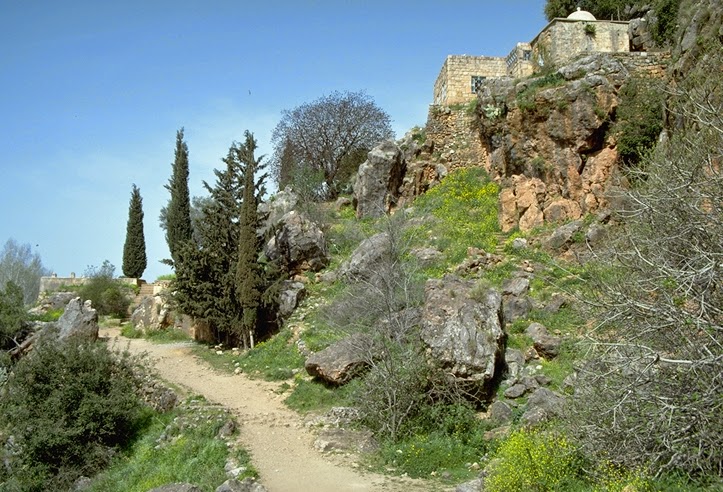
The passage for this Sunday’s Gospel is the proclamation of Jesus Christ as Messiah and Son of the Living God. It is Peter’s proclamation on the road to Caesarea Philippi. It is an important theological passage for Christianity, and an important passage within the Gospel of Matthew.
We begin with Jesus’ question to his disciples. This then reveals that Jesus is a great prophet. It isn’t simply that he is compared to the great heroes of the Jewish faith. He is on par with, he is equal to, Jeremiah, Elijah, and John the Baptist. He is not simply a great prophet; he is the greatest of prophets. He is the Christ, Son of the Living God. The message of Jesus is the continuation of the ancient faith of Israel. He is the fulfillment of all the hope of Israel. He is the omega of salvation history. At the same time he is doing something radically new — he is birthing, through word and Spirit, the Church.
Jesus in Matthew’s Gospel is the one who is laying the foundation of a living Word that will withstand the powers and principalities of both this world and the world to come. He is building up living stones and a kingdom of priests to expand the reign of the kingdom of God — this “eschatological temple.” (Allison/Davies, Matthew, 642)
There is a great debate among scholars as to Matthew’s own Christology. Did he think of Jesus as God in the same way as John and his Gospel? In point of fact no direct statement is made. Yet in my opinion the author of this Gospel indeed understands Jesus as God. For in my reading of Matthew, Jesus not only is the continuum of messianic hope, he is the culmination as well. He is here on this road proclaimed as the Son of the Living God. Matthew’s Gospel is clear about its revelation: Jesus is one with God, and therefore transcends the simple relationship of follower or prophet of the Most High God.
Furthermore, this Jesus is the one who has been given the power and authority to call forth the new community of faithful followers into the kingdom. In this section of the narrative, in this moment, on the road to Caesarea Philippi, Jesus is seen as Lord of this new kingdom. He is in the miracle of loaves and fishes, in the stilling of the storm; he is bringing together a new people of God. This new people of God is made up of those who, unlike many of the religious powers of his day, have not rejected him, and those who are on the fringes of religious society — to include Gentiles. This is the God made man who, in sitting and eating with sinners and tax collectors, is binding together a new family of God.
Jesus in his ministry, and from this point on in Matthew’s Gospel, is passing along the inheritance of the kingdom of God. Jesus is gathering in and multiplying the numbers of Abraham’s descendants. He is, through the power of the Holy Spirit, taking the spirit that has been under the custodial leadership of the religious authorities of his day and placing that spirit upon a new people, a growing people, a diverse people — the ecclesia, the People of God.
The image of this new people of God is not the perfected disciple but the disciple Peter: the one whose faith led him to step out of the boat, the one whose faith has revealed the true nature of Jesus, the one who also will struggle with his faith and deny him during Passiontide. This imperfect human is the one upon whom the church, the new ecclesia, is built.
Jesus is the Son promised in 2 Sam 7:4–16, the king who builds the eschatological temple. This temple is the church. Like the old temple, it is founded on a rock. But unlike the old temple, it has no geographical location. It is not in Jerusalem. The new, eschatological temple is a spiritual temple. It stands under the rule: “Where two or three are gathered in my name, there am I in the midst of them” (18:20; cf. Jn 4:21). Matthew is thus at one with the rest of the NT in substituting for the holiness of place the holiness of a person: holy space has been Christified.
Allison and Davies contend — and I think it is a great image — that just as Jesus is himself the New Covenant, so Peter is then the New Abraham. They write:
The parallels between 16:13–20 and Genesis 17:1–8 indicate that Peter functions as a new Abraham. He is the first of his kind, and he stands at the head of a new people. Peter is, like Abraham, a rock (cf. Isa 51:1–2), and the change in his name denotes his function. What follows? Peter is not just a representative disciple, as so many Protestant exegetes have been anxious to maintain. Nor is he obviously the first holder of an office others will someday hold, as Roman Catholic tradition has so steadfastly maintained. Rather, he is a man with a unique role in salvation history. The eschatological revelation vouchsafed to him opens a new era. His person marks a change in the times. His significance is the significance of Abraham, which is to say: his faith is the means by which God brings a new people into being.
This week’s Gospel lesson is as much about Jesus as it is about Peter. We need leaders in each Episcopal congregation, clergy and lay, who are ready to give voice to the proclamation of Jesus as Son of the Living God and Lord of all, and to incarnate their faith by living a living Word that is Gospel. We need leadership who will also see themselves not simply as disciples of a particular kind, but in the tradition of Peter and Abraham, ready to take steps out into the world. We need leadership ready to be the stones upon which new churches are designed and built. We need leaders who through their ministry are ushering in a new era of Gospel proclamation and mission. We need leaders by means of whose faith God is bringing a new people, a new ecclesia, into being.
“And here we offer and present unto thee, O Lord, our selves, our souls and bodies, to be a reasonable, holy, and living sacrifice unto thee.” — Paul’s appeal in Romans 12:1 is not an idea the Church admires from a distance. It is the sentence we say over the bread and wine, about ourselves, at every Rite One Eucharist.
“To be enslaved to sin is to have one’s body commandeered every bit as much as one’s soul.”
“Paul’s main point about spiritual gifts, mentioned in verse 6, is that God has given us these as members of the body of Christ. So we are to use the particular gift God has given us to help the body function, not to promote ourselves or show how we as one body part are better than others who are another body part.”
Romans is about God’s unconditional, one-way love that in the end will conquer all powers and principalities and make us heirs and family members with God.
Paul invites the members of the community at Rome to make an offering in response to God’s action on our behalf. We are invited to present ourselves and our very life as a sacrifice — not like those sacrifices made in the Temple on our behalf, but to be the sacrifice and offering to God, because in so doing we will experience transformation.
Our grateful response to God is to discern our life and its patterns as a reflection of the God who loves us. We can easily go back to the way of the world. We can try to live by the law. We can try to purchase or buy our sacrifice, but nothing will lead to the same life that God is freely offering to each of us. So we have to begin again. We must realize that we must daily start anew. We respond to God’s never-failing love for us by each day committing ourselves to a grateful response.
Our bodies, our gifts, our very life are given to us as a part of the whole life of God on earth. We are members of a great cloud of witnesses, a great body of Christ. Each of us is given part of the work of carrying out God’s mercy in the world. The Holy Spirit, which makes us part of the one body of Christ, also enlivens us to be an active member in our community and out in the world. We are all given unique qualities which reflect the God we believe in and the God who animates all creation. Yet we are not independent but interdependent members. We depend upon one another and are part of one another’s life and livelihood.
This interdependence is for the building up of the kingdom of God and the manifestation of grace in the world around us. Our uniqueness and our unique gifts are part of the wider community and its overall functioning. Gifts are each dependent upon the others. So Paul continues: as one body in Christ, the gift of prophecy (inspired preaching) is dependent upon the gift of ministry — the administration of aid and distribution of alms. Teaching is dependent upon exhortation, the urging of others to have faith. (See Chris Haslam’s site for the breakdown.) All of these are gifts that work together in harmony and unity.
For as in one body we have many members, and not all the members have the same function, so we, who are many, are one body in Christ, and individually we are members one of another. We have gifts that differ according to the grace given to us: prophecy, in proportion to faith; ministry, in ministering; the teacher, in teaching; the exhorter, in exhortation; the giver, in generosity; the leader, in diligence; the compassionate, in cheerfulness.
As one body there are many members, and we are all in need of the other.
I think the challenge here is that we don’t truly engage this notion that all have gifts. We don’t really take time to figure this out with people. We are typically only interested in the gifts that help run the church. Any gift that might take more time or cause a disruption in the gentle order of things is a gift discarded. We have decided that the gifts of preaching, teaching, church planting, and leadership belong only to those with advanced training and three years of master’s study.
Paul points out the truth of Jesus and his call to those first fishermen. Paul points out the truth of the call to the first apostles appointed by the Holy Spirit — none of them had an MDiv. They were all kinds and sorts of people. They were poor and wealthy. They were wise and simple. Yet all received their gifts from the Holy Spirit. They gave their lives to the health and vitality of the kingdom of God.
So I wonder: do we dare preach the truth this Sunday? Even though it will cause a fair bit of trouble for those in power and enmeshed in the hierarchy… courage is probably the right tactic here.
On the midwives who lied to Pharaoh: they “were according to their degree approved and rewarded of God. For if a person who is used to tell lies for harm’s sake comes to tell them for the sake of doing good, that person has made great progress. … It is one thing that is set forth as laudable in itself, another that in comparison with a worse is preferred.” — Augustine will not let us call the deception good; he will only call it better. Worth arguing with before Sunday.
“This ancient text from Exodus echoes powerfully in our congregations, nation and world: issues of race and politics, religion and politics, gender and power, the war on terror, debates over immigration policy, the inequities of our global economy, congregational mission and hospitality to the stranger, and all manner of suffering and bondage that threaten the individuals and families with whom we minister.”
“The story highlights the cleverness and understated bravado of the women agents who defy Pharaoh.”
“It’s a courageous act of civil disobedience that changes history, for one of the boys that is spared will be called Moses and he will lead the Israelites out of Egyptian captivity.”
Today’s passage is the beginning of the story of Moses, and it starts as Pharaoh goes mad. He attempts to kill all the children in order to decrease the growing population of Israelites. Like a “genesis” narrative — a “how did we come to be in Egypt” narrative — it is a story of beginnings. It begins with these words: “These are the names of the sons of Israel who came to Egypt with Jacob, each with his own household … Then Joseph died … and that whole generation.”
The Pharaoh no longer remembers Joseph and his family. There are too many Israelites now, and he is using them to build up his cities. They no longer rule side by side; instead they are slave labor. Their numbers continue to increase, so Pharaoh tells the midwives to kill the male babies — but they resist. Moses is saved. In fact he is saved by a daughter of Pharaoh and brought up as an Egyptian. So the repetition now begins: the favorite son, saved from death, is now given life — one that will in the end save God’s people and bring them a bit further on their journey.
The story of the sacrifice of the male children is of course echoed in the story of Jesus and the death of the innocents in Matthew’s Gospel. This is important, because in the Gospel of Matthew, Moses is a prefiguring character. We already talked about the theology of this in our last post. In Matthew’s Gospel, Jesus is like Moses — a great prophet. Jesus is protected from the genocide of male children. He returns from Egypt. Jesus, like Moses, fasts for forty days. Jesus is the great shepherd of God’s sheep and is sent to free them because of God’s passion for them. Even Matthew’s transfiguration is filled with Moses typology. (Richard Hays in Echoes of Scripture in the Gospels certainly draws this parallel well; it is present in Allison and Davies’ work as well.)
Jesus asks the disciples what other people say before he asks what they say. Whose account of Jesus have you been living on second-hand, and what would it cost you to answer the question yourself?
Paul says the gifts differ. Which gift in your congregation has been discarded because it would take too much time or disturb the gentle order of things?

No comments:
Post a Comment